
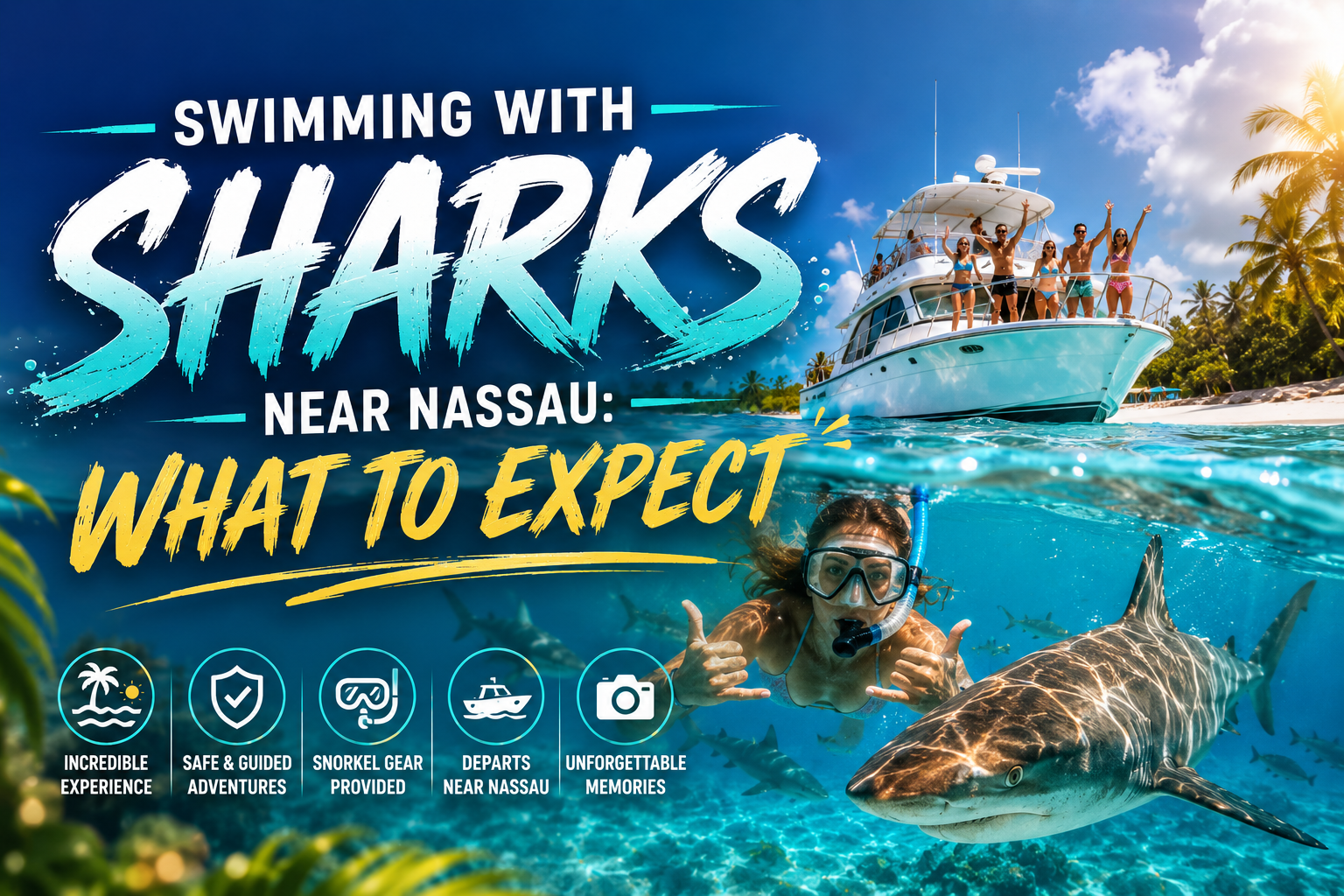
Swimming with Sharks Near Nassau: What to Expect
Few wildlife encounters create the same mixture of excitement and nervous anticipation as entering the water where sharks are present.
For travelers visiting Nassau, the idea can sound intimidating at first. Sharks are powerful wild animals, and popular culture has spent decades portraying almost every encounter with them as dangerous. The reality of an organized shark experience is much more nuanced.
Depending on the excursion, location, weather, and operator, visitors may observe sharks while snorkeling, diving, or from a boat. The species encountered can vary, as can the structure of the experience. Some trips make sharks the primary attraction, while others encounter them as part of a broader snorkeling or wildlife itinerary.
Knowing what to expect before leaving Nassau can make the experience considerably more comfortable.
Shark Encounters in the Bahamas Are Different From an Aquarium Experience
The first thing to understand is that these are wild animals.
There is no guarantee that a particular shark will appear in a particular place at a particular moment.
Ocean conditions change.
Animals move.
Weather affects visibility.
Wildlife encounters should therefore be approached differently from attractions with predictable schedules.
That unpredictability is also what makes seeing a shark in its natural environment so memorable.
What Sharks Might You See Near Nassau?
The Bahamas supports numerous shark species.
Exactly what you might encounter depends on where the excursion travels and the type of experience being offered.
Species associated with Bahamian waters can include:
- Caribbean reef sharks
- Nurse sharks
- Lemon sharks
- Tiger sharks
- Hammerheads
- Other offshore species
Not all of these are commonly encountered on excursions from Nassau, and some are associated much more strongly with other parts of the Bahamas.
A reputable operator should explain which species are realistically expected on the specific trip you are considering.
Caribbean Reef Sharks
Caribbean reef sharks are among the species visitors may associate with shark diving in the Bahamas.
They have the streamlined appearance many people picture when imagining a shark.
Seeing one underwater can be striking because the animal often appears much calmer and more deliberate than people expect.
Rather than frantic movement, sharks frequently seem remarkably efficient as they move through the water.
Nurse Sharks
Nurse sharks look quite different from the stereotypical image of a fast-moving open-water shark.
They are often seen resting near the bottom and are associated with warm, relatively shallow environments.
Their slower appearance can make visitors assume they are harmless.
That is the wrong lesson to take from their behavior.
Nurse sharks are still wild animals and should never be grabbed, chased, cornered, or treated like pets.
Lemon Sharks
Lemon sharks inhabit parts of the Bahamas and are often associated with shallow coastal habitats.
They can grow quite large.
As with other shark species, the appropriate response is observation rather than interaction.
The goal of a responsible wildlife encounter should be to watch the animal behave naturally while following the guide’s instructions.
Tiger Sharks and Hammerheads
The Bahamas is internationally known among experienced divers for encounters with tiger sharks and hammerheads.
However, famous shark-diving areas associated with these species are not necessarily right outside Nassau.
The Bahamas is an extensive archipelago.
An experience promoted somewhere in the country should not automatically be interpreted as something available on a short excursion from New Providence.
This geographic distinction matters when planning a trip.
Ask Which Species the Excursion Actually Targets
“Shark experience” is a broad description.
Before booking, ask:
- Which species are normally encountered?
- Where does the excursion go?
- Is the activity snorkeling or scuba diving?
- Are sightings expected or incidental?
- How deep is the water?
- What level of swimming experience is required?
Specific answers are much more useful than generic promises about swimming with sharks.
What the Experience Usually Feels Like
For many first-time participants, the most intense part happens before entering the water.
Once someone knows sharks may be below, every shadow suddenly looks important.
Then the first shark appears.
What surprises many people is how controlled its movement can look.
The animal may glide rather than rush.
It can disappear into deeper water and return almost silently.
That first sighting often replaces some of the abstract fear with focused attention.
You May Feel Nervous Even If You Are a Strong Swimmer
Being comfortable in the ocean does not automatically mean being comfortable around sharks.
Someone can snorkel regularly and still feel apprehensive.
That is reasonable.
Tell the guide if you are nervous.
Good guides should explain:
- How to enter the water
- Where to stay
- How the group will be positioned
- What behavior to avoid
- How to exit
Understanding the procedure usually makes the experience feel less chaotic.
The Briefing Is One of the Most Important Parts of the Trip
Do not treat the safety briefing as something to endure before the interesting part begins.
Listen carefully.
Instructions may vary according to:
- Species
- Location
- Current
- Visibility
- Water depth
- Type of activity
Follow the instructions given for that specific excursion rather than relying on advice from a video you watched online.
Don’t Improvise Around Wildlife
Shark encounters are not the time to create your own underwater adventure.
If the guide tells the group to remain together, remain together.
If participants are instructed not to dive below the surface, do not dive below the surface for a photograph.
If the guide says it is time to return to the boat, return.
Wildlife experiences are safest when participants behave predictably.
Swimming Ability Matters
Some shark experiences are accessible to competent recreational snorkelers.
Others require scuba certification or significant diving experience.
Before booking, understand whether the excursion involves:
- Floating at the surface
- Snorkeling
- Freediving
- Scuba diving
- Deep water
- Current
Be realistic about your swimming ability.
An open-ocean excursion is not a good place to discover that snorkeling makes you uncomfortable.
Life Jackets and Flotation Devices
Depending on the activity and operator, flotation equipment may be available or required.
A flotation device can help less-confident snorkelers conserve energy.
However, wearing one does not substitute for following safety instructions.
Ask what equipment is supplied before leaving Nassau.
Snorkeling and Diving Are Very Different Experiences
A snorkeler typically observes from the surface.
A scuba diver can remain underwater and see the animals from an entirely different perspective.
Neither is automatically “better.”
Snorkeling may be more accessible.
Diving can provide longer underwater observation but requires appropriate certification, training, and equipment.
Choose according to your actual experience rather than whichever option sounds more dramatic.
Visibility Changes the Experience
Clear Bahamian water can create exceptional viewing conditions.
But visibility is not identical every day.
Wind, waves, currents, weather, and local conditions can all influence underwater visibility.
On an exceptionally clear day, you may see a shark approaching from a considerable distance.
In reduced visibility, the animal may appear much closer before you notice it.
That difference can dramatically change how the encounter feels.
Water Depth Can Affect Confidence
Some people feel comfortable snorkeling in 10 feet of water but become nervous when the bottom disappears below them.
That psychological difference is worth recognizing.
If deep water makes you uncomfortable, ask about the location before booking.
You should understand the environment rather than discovering it after jumping from the boat.
Enter the Water Calmly
Follow the crew’s instructions regarding entry.
Avoid unnecessary splashing.
Once in the water, focus on:
- Breathing steadily
- Positioning yourself comfortably
- Staying aware of the group
- Listening to the guide
People sometimes become so focused on finding sharks that they stop paying attention to their own position.
Maintain situational awareness.
Stay With the Group
A guided shark experience is not an opportunity to swim away independently looking for a better angle.
Stay where the crew instructs.
Group positioning can be an important part of how an excursion is managed.
It also makes it easier for guides to monitor participants.
Keep Your Hands to Yourself
This should be straightforward.
Do not attempt to:
- Touch sharks
- Grab fins
- Ride animals
- Block their movement
- Chase them
The same principle applies to other wildlife encountered during the excursion.
Observation is enough.
Sharks Need Space
A photograph can make a shark appear farther away than it actually is.
Do not move closer simply because you want a dramatic image.
Let the animal determine its own movement.
If a shark approaches, remain attentive to the guide’s instructions rather than trying to manufacture an interaction.
Never Assume a Calm Shark Wants to Be Touched
An animal moving slowly is not inviting contact.
Wildlife does not need to appear aggressive to deserve space.
This is especially important with species such as nurse sharks, whose relatively calm appearance can cause visitors to become overly comfortable.
Respectful distance protects both participants and animals.
What Should You Wear?
For a typical warm-water excursion, appropriate gear may include:
- Swimsuit
- Rash guard
- Snorkeling equipment
- Appropriate flotation equipment
- Wetsuit when conditions or the activity call for one
The operator should explain what is provided and what guests need to bring.
A rash guard can also provide useful sun protection during a long day on the water.
Sun Protection Matters More Than You Think
A shark may be the most exciting part of the day, but the Caribbean sun is a much more predictable concern.
Boat trips can involve hours of exposure.
Consider:
- Protective clothing
- Hat
- Sunglasses
- Appropriate sunscreen
- Water
Follow local and operator guidance regarding sunscreen use and marine environments.
Hydrate Before You Get in the Water
Travelers sometimes spend the morning drinking coffee, rush to the marina, and forget water entirely.
Heat, sun, swimming, and boat travel can be tiring.
Drink water before and during the excursion when appropriate.
This becomes especially important on longer trips.
Eat Sensibly Before the Excursion
You generally do not want to begin a boat trip either extremely hungry or uncomfortably full.
If you are prone to seasickness, follow appropriate guidance for managing it.
A shark encounter becomes considerably less exciting when all your attention is focused on your stomach.
Seasickness Can Be a Bigger Issue Than the Sharks
Some visitors spend days worrying about sharks and then discover the boat ride was the challenging part.
Ocean conditions around Nassau can vary.
If you are susceptible to motion sickness, consider discussing appropriate preventative measures with a healthcare professional or pharmacist before the trip.
Do not wait until you are already uncomfortable offshore to start thinking about it.
Weather Can Change the Plan
Marine excursions depend heavily on weather.
Wind and sea conditions can influence:
- Visibility
- Comfort
- Safety
- Route
- Wildlife activity
An operator may alter or cancel a trip when conditions are unsuitable.
That can be disappointing, particularly when the excursion was a major reason for visiting Nassau.
Safety should still take priority over maintaining the itinerary.
Wildlife Sightings Cannot Be Guaranteed
Sharks are not employees.
They do not have a schedule.
Even areas known for particular species can experience variation.
Be cautious about interpreting wildlife marketing as an absolute guarantee unless the operator clearly explains what its guarantee actually means.
A responsible expectation is that the crew knows where encounters are historically likely, not that nature will always cooperate.
Swimming With Sharks Nassau Experiences Can Be Surprisingly Peaceful
For many travelers, the most unexpected part of swimming with sharks nassau is not an adrenaline rush but the quietness of watching these animals underwater. Once the initial nervousness fades, attention often shifts toward their movement, shape, distance, and relationship with the surrounding environment.
The experience can challenge the exaggerated image of sharks many people develop from movies.
That does not mean forgetting that they are wild predators.
It means replacing panic with informed respect.
The Best Experiences Are Not About Proving Bravery
There is no prize for being the person who swims closest.
A wildlife encounter should not become a competition.
You do not need to:
- Dive toward the shark
- Touch it
- Pose beside it
- Separate from the group
to have an extraordinary experience.
Simply watching a shark move through clear Bahamian water can be memorable enough.
Underwater Photography Requires Practice
Trying to operate a camera while snorkeling can be harder than expected.
You need to manage:
- Breathing
- Buoyancy
- Position
- Current
- Other swimmers
while also framing the photograph.
If you are inexperienced, prioritize comfort and awareness over getting perfect footage.
The shark does not need to appear three inches from the lens for the image to be worthwhile.
Wide-Angle Views Can Tell a Better Story
Some of the most interesting underwater photographs show the shark in context.
Including:
- Blue water
- Reef
- Other marine life
- Divers
can communicate the scale and environment more effectively than an extremely tight image.
Distance can also produce a more natural representation of the encounter.
Don’t Chase Wildlife for Social Media
A dramatic video is not worth disturbing an animal or ignoring safety instructions.
Social media can encourage people to move increasingly close to wildlife because extreme footage attracts attention.
Resist that pressure.
The objective should be experiencing the environment responsibly, not manufacturing a viral moment.
You May See Much More Than Sharks
A trip focused on sharks can still provide opportunities to observe other marine life.
Depending on location and conditions, that could include:
- Tropical fish
- Rays
- Sea turtles
- Coral
- Other reef species
Keep looking around.
Sometimes the unexpected wildlife encounter becomes as memorable as the one you originally booked.
Reef Environments Deserve Respect
If the excursion takes place near coral, avoid:
- Standing on coral
- Kicking it with fins
- Grabbing it for balance
- Collecting pieces
Coral structures are living ecosystems.
Good buoyancy and careful fin movement help protect them.
Don’t Collect Marine Life
Shells, coral fragments, animals, and other natural objects should generally remain where they belong unless local rules explicitly permit otherwise.
A photograph is a much better souvenir from a wildlife experience.
Choosing an Operator Matters
Not all wildlife excursions operate in exactly the same way.
Before booking, research:
- Safety procedures
- Guide experience
- Group size
- Equipment
- Vessel
- Wildlife practices
- Customer feedback
Price matters, but it should not be the only factor.
An exceptionally cheap excursion is not automatically good value if the experience is poorly managed.
Ask About Group Size
Group size can influence the experience significantly.
A smaller group may make it easier to:
- Hear instructions
- Enter the water efficiently
- Maintain awareness
- Observe wildlife without crowding
Larger groups are not automatically unsafe, but organization becomes increasingly important.
Ask how many participants are normally taken.
Ask About the Crew
Useful questions can include:
- Who leads the water activity?
- What experience do the guides have?
- Is first-aid equipment carried?
- What emergency procedures are used?
- What safety equipment is aboard?
A professional operator should be able to discuss safety confidently.
Understand the Boat Ride
The actual wildlife encounter may represent only one portion of the excursion.
Ask:
- How long is the trip?
- How much time is spent traveling?
- Is the boat shaded?
- Is there a restroom?
- Is drinking water available?
- How much time is spent in the water?
These details can matter enormously, particularly for families.
Families Should Review Age Requirements
Parents should not assume that every shark excursion is appropriate for children.
Operators may establish:
- Minimum ages
- Swimming requirements
- Certification requirements
- Parental supervision rules
Even when a child technically meets the minimum age, parents should consider the child’s actual comfort in open water.
A Child Who Loves Sharks May Still Fear the Ocean
Watching shark documentaries at home and entering deep water beside a shark are very different experiences.
Do not pressure a nervous child into participating simply because the excursion has already been paid for.
Some operators may allow guests to remain on the boat.
Ask beforehand what options are available.
Non-Swimmers Should Ask Before Booking
Some wildlife trips allow passengers to remain aboard and watch from the boat.
Others are primarily designed around an in-water experience.
If someone in your group does not swim, clarify what they will realistically be able to see and do.
Do not assume the excursion will provide an equally satisfying boat-only experience.
Cruise Passengers Need to Watch the Clock
Visitors arriving in Nassau by cruise ship have a fixed deadline.
If booking an independent excursion, understand:
- Meeting location
- Departure time
- Trip duration
- Transportation
- Return time
Allow a reasonable buffer.
A ship departure is not something to cut close after an offshore excursion.
Hotel Guests Have More Flexibility
Visitors staying on New Providence usually have greater flexibility regarding departure times.
That can make it easier to choose:
- Morning excursions
- Longer trips
- Weather backup days
If shark encounters are a major priority, scheduling the excursion earlier in the vacation can provide more flexibility if weather causes a cancellation.
Morning Trips Can Be Appealing
Morning departures may offer:
- Cooler temperatures
- A fresh start
- More afternoon flexibility
Conditions vary, however, and there is no universal rule that morning always produces better shark encounters.
Choose according to the operator’s recommendations and your schedule.
Build a Backup Day Into the Vacation
If this is a bucket-list activity, avoid scheduling it for the final possible morning before your flight home.
Weather happens.
Mechanical issues happen.
Marine conditions change.
Having another available day gives you options if the original trip cannot operate.
Understand Cancellation Policies
Before paying, check what happens if:
- Weather cancels the trip
- The operator cancels
- You become ill
- Your cruise itinerary changes
- You decide not to participate
Refund and rescheduling policies vary.
Read them before booking rather than after plans change.
Don’t Confuse “Shark Encounter” With One Standard Activity
Different excursions can use similar language for very different experiences.
One may involve snorkeling.
Another may involve scuba diving.
Another might primarily observe sharks from the boat.
The title of the excursion tells you less than the actual itinerary.
Read the complete activity description.
Feeding Practices Are Worth Asking About
Some shark-tourism operations use food or other techniques to attract sharks, while other encounters occur without feeding.
This is an area where practices, regulations, species, and opinions can vary.
If this matters to you, ask the operator directly:
- Whether sharks are fed
- How interactions are conducted
- What wildlife guidelines are followed
Choose an experience consistent with your comfort level and expectations.
Responsible Wildlife Tourism Should Minimize Disturbance
A good encounter should prioritize more than customer entertainment.
Wildlife tourism has consequences.
Operators should think about how their activities influence animal behavior and the surrounding environment.
As a traveler, you can support better practices by choosing companies that treat marine life as wildlife rather than props.
Sharks Play Important Ecological Roles
Sharks occupy important positions within marine ecosystems.
Different species play different ecological roles, but sharks broadly contribute to complex ocean food webs.
Seeing them in their natural environment can transform the way visitors think about them.
An animal previously understood primarily as a threat becomes part of a much larger ecosystem.
Fear Often Comes From What We Cannot See
The ocean naturally creates uncertainty.
On land, people can usually see what surrounds them.
Underwater, visibility is limited and humans are outside their normal environment.
Add sharks and imagination can fill the unseen space quickly.
Good guides, clear water, and understanding the procedure can make that uncertainty easier to manage.
It Is Okay to Decide Not to Enter the Water
You may board the boat fully intending to snorkel and then feel differently once you reach the site.
That does not mean the trip was a failure.
Wildlife encounters should be voluntary.
If you are uncomfortable, tell the crew.
Depending on the excursion, observing from the boat may still be possible.
There is no reason to enter the water solely because everyone else does.
Don’t Hide Panic From the Guide
If you enter the water and become overwhelmed, communicate.
Panic can interfere with:
- Breathing
- Swimming
- Awareness
- Following instructions
Guides need to know when someone is struggling.
Returning to the boat is always better than pretending everything is fine while becoming increasingly distressed.
Controlled Breathing Can Help
Snorkeling already requires becoming comfortable breathing through a tube while your face is underwater.
Add the sight of a shark and breathing can become noticeably faster.
Focus on slow, regular breaths.
Give yourself time to adjust.
You do not need to be the first person in the water.
What Does the Shark Encounter Look Like Underwater?
Imagine looking into clear blue water.
At first, there may be nothing obvious.
Then a shape appears below.
It moves across your field of vision with surprisingly little effort.
Another may appear farther away.
The experience can feel completely different from watching sharks through glass or on television because there is no visual boundary separating you from the environment.
That awareness is what makes the encounter powerful.
Distance Can Be Difficult to Judge Underwater
Water affects visual perception.
Objects can appear different in size and distance than expected.
Do not make assumptions about how far away an animal is.
Maintain the position recommended by the guide.
Sharks May Come and Go
Do not expect the animals to remain directly beneath the group.
They may:
- Approach
- Turn
- Disappear
- Reappear
This movement is part of observing wild animals.
Avoid chasing after one when it moves away.
Give Yourself Time to Look Without a Camera
There is a temptation to record the entire encounter.
Try spending at least part of it simply watching.
A camera captures what was in front of you.
It does not necessarily capture the feeling of floating in open water while a shark passes below.
Some experiences are better remembered directly.
After the First Shark, Your Perspective May Change
Many people enter the water focused entirely on danger.
After several minutes, they begin noticing details:
- How the shark turns
- How little energy it seems to use
- How it responds to other sharks
- How it moves relative to the reef
- How quickly it disappears into blue water
Fear can gradually become curiosity.
That transition is often one of the most interesting parts of the experience.
Don’t Become Overconfident
Feeling comfortable is good.
Forgetting that the animals are wild is not.
Continue following instructions even after the initial nervousness disappears.
Familiarity during a 30-minute encounter does not make someone an expert in shark behavior.
Respect should remain constant.
What to Bring
A practical day bag may include:
- Swimsuit
- Towel
- Rash guard
- Hat
- Sunglasses
- Water
- Appropriate sun protection
- Underwater camera if desired
- Dry clothing
- Waterproof bag or pouch
Ask the operator what equipment is already included before bringing unnecessary gear.
Leave Valuable Jewelry Behind
Boat excursions and open water are not ideal environments for expensive jewelry.
Rings, bracelets, watches, and necklaces can:
- Get lost
- Become damaged
- Create unnecessary worry
Bring only what you genuinely need.
The ocean is very good at keeping things that fall into it.
A Sample Shark Excursion Day
A typical experience might unfold something like this:
Arrival: Meet the operator and complete check-in.
Briefing: Learn about the boat, activity, equipment, and safety procedures.
Boat ride: Travel from Nassau toward the wildlife area.
Site briefing: Receive specific instructions for entering the water and positioning.
Water entry: Enter according to crew directions.
Observation: Watch the sharks while remaining with the group.
Exit: Return to the boat when instructed.
Return trip: Head back toward Nassau.
The exact itinerary can vary considerably between operators.
Questions to Ask Before Booking
Before choosing an excursion, ask:
- Which shark species are commonly encountered?
- Is the experience snorkeling or scuba diving?
- What swimming ability is required?
- How deep is the water?
- How large are the groups?
- What equipment is provided?
- What safety procedures are used?
- Are sharks fed or otherwise attracted?
- How long is the boat ride?
- How long is the complete excursion?
- Are there age restrictions?
- What happens during poor weather?
- What is the cancellation policy?
- Can someone remain on the boat instead of swimming?
- Is the schedule appropriate for cruise passengers?
Specific questions produce better expectations.
Common Mistakes to Avoid
Choosing an Excursion Based Only on Price
Safety, professionalism, equipment, and group management matter.
Assuming Every Shark Experience Is the Same
Snorkeling, diving, and observation trips can be completely different.
Ignoring Swimming Requirements
Open-water confidence matters.
Chasing Sharks for Photographs
Let wildlife determine its own movement.
Touching Animals
Observation should remain observation.
Forgetting About Sun and Seasickness
These are much more predictable problems than dramatic shark encounters.
Scheduling the Trip Too Close to a Cruise Departure
Allow sufficient time to return.
Expecting Guaranteed Wildlife Behavior
Sharks are wild animals.
FAQs
Is it possible to swim with sharks near Nassau?
Shark-related excursions may be available from Nassau, but experiences vary considerably in location, species, activity type, and seasonal availability. Confirm the current itinerary directly with the operator.
What kinds of sharks can be found in the Bahamas?
Bahamian waters support numerous species, including Caribbean reef sharks, nurse sharks, lemon sharks, tiger sharks, and hammerheads. The species commonly encountered near a particular excursion site can be much more limited.
Do I need to be an experienced swimmer?
Requirements vary. Some snorkeling experiences may be suitable for competent recreational swimmers, while scuba experiences can require certification and greater experience. Ask about depth, currents, and flotation equipment before booking.
Can children participate in shark excursions?
Some operators permit children who meet specific age and swimming requirements, while others have stricter limitations. Parents should consider both formal requirements and the child’s actual comfort in open water.
Are shark sightings guaranteed?
Wildlife behavior cannot be predicted with certainty. Operators may visit areas where encounters are common, but conditions and animal movements can change.
Can I touch the sharks?
Visitors should not assume touching wildlife is permitted or appropriate. Follow the operator’s instructions and maintain respectful distance.
What happens if I become scared once I am in the water?
Communicate with the guide immediately. Depending on the situation and excursion, you may be able to return to the boat. There is no reason to remain in the water if you are uncomfortable.
Should I bring an underwater camera?
You can if the operator permits it, but photography should never interfere with your ability to swim safely, remain with the group, or follow instructions.
Final Thoughts
Swimming near sharks can sound like an experience built entirely around adrenaline.
For many people, it becomes something different.
The initial moment may be intimidating. Your breathing gets faster. Every shadow attracts attention. Then a shark appears beneath the surface and the abstract idea becomes a real animal moving through its own environment.
That perspective can change the experience completely.
A responsible shark encounter is not about touching an animal, swimming closer than everyone else, or returning home with the most dramatic photograph.
It is about observation.
Choose an experienced operator, understand exactly what type of excursion you are booking, be realistic about your swimming ability, listen carefully to the briefing, and respect the animals throughout the experience.
You may arrive expecting the most frightening moment of your Nassau vacation.
You may leave remembering something much quieter: the effortless movement of a shark disappearing into the blue.