
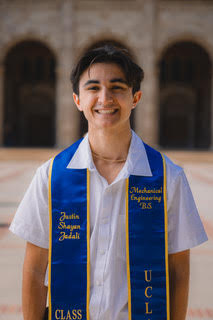
Not every path into graduate research at an institution like Yale runs through a conventional four-year undergraduate program. Justin Jadali‘s did not. His academic trajectory — from Irvine Valley College to UCLA to a master’s program at Yale — was shaped by deliberate choices about how to build a skill set that does not fit neatly into a single discipline. Understanding how he got here matters, because the path explains a great deal about how he works.
Jadali is now completing an M.S. in Mechanical Engineering and Materials Science at Yale, where his research centers on alginate-based microparticle systems and microvessel formation in tissue engineering. The research requires him to fabricate biomaterials, culture multiple cell types, operate microscopy workflows, and design experiments with the kind of precision that makes the resulting data useful. That range of capability did not come from a single department. It was assembled intentionally, across institutions and disciplines, over the course of an academic career that started earlier than most.
Skipping the Conventional Starting Point
Jadali earned a 36 on the ACT and made the decision to skip his final two years of high school, enrolling instead at Irvine Valley College. There, he completed three Associate of Science degrees — in Physics, Mathematics, and Natural Sciences — before transferring to UCLA.
Community college transfer pathways into competitive four-year universities are sometimes described as non-traditional, but that framing undersells what they require. Students who move from a community college into a program like UCLA Mechanical Engineering typically enter with coursework that must hold up against peers who attended selective high schools and preparatory programs. Jadali’s three A.S. degrees, with their grounding in physics and mathematics, provided the technical foundation his engineering program demanded.
More relevant to his research trajectory, completing degrees in Natural Sciences alongside Physics and Mathematics positioned Jadali early to think across disciplinary lines — a habit of mind that would become central to how he approaches biomedical research.
Engineering Curriculum, Deliberately Extended
At UCLA, Jadali graduated with a B.S. in Mechanical Engineering as part of the Class of 2025. The degree is a rigorous one — covering mechanics, materials, thermodynamics, fluid dynamics, manufacturing, and systems design. Most mechanical engineering students stop there when it comes to life sciences.
Jadali did not. He completed a full year of biology and a full year of organic chemistry alongside his engineering curriculum. The decision was strategic. Tissue engineering, regenerative medicine, and bioprinting are fields where the barrier to meaningful contribution is not engineering knowledge alone — it is the combination of engineering knowledge with an accurate understanding of how cells behave, how biological materials respond to chemical and mechanical stimuli, and how molecular-scale phenomena translate into macroscopic outcomes.
Organic chemistry, in particular, is not a course most mechanical engineers take by choice. It is demanding, detailed, and typically considered outside the scope of what an engineer needs to know. For a researcher who would later be designing alginate crosslinking systems and evaluating how ion chemistry affects biomaterial behavior, it was directly applicable.
What Mechanical Engineering Brings to Biomedical Research
The question of what mechanical engineers contribute to biomedical research is worth addressing directly, because the answer is not obvious from the outside.
Engineers who enter biomedical research bring a systems orientation — a tendency to ask how components interact, where failure points are, and how to design processes that produce consistent outputs. They also bring training in materials behavior, fabrication methods, and quantitative analysis that is applied differently in life science contexts than in traditional engineering roles.
In Jadali’s case, the mechanical engineering background manifests in several ways. His microparticle fabrication work applies materials science principles — crosslinking chemistry, gelation kinetics, mechanical characterization — to a biological context. His emphasis on SOP design and batch documentation reflects engineering quality control culture. His engagement with additive manufacturing, which he has pursued for years and now applies to bioprinted tissue constructs, draws on prototyping and fabrication training that is foundational in mechanical engineering programs.
At the same time, the biology and organic chemistry coursework he completed at UCLA means he can interpret cell behavior, not just measure it. When endothelial cells, pericytes, and fibroblasts respond differently to microparticles crosslinked with calcium versus zinc, Jadali has the background to reason about why — not just document that the difference exists.
Building Systems Outside the Lab
Before graduate school, Jadali founded an e-commerce company specializing in exotic insects and affiliated supplies. The business grew to approximately 10 employees and was later sold at a six-figure valuation.
The relevance of that experience to a research career is not immediately obvious, but it is real. Running a business that scales to 10 employees requires building processes that work without constant direct oversight — inventory systems, supplier relationships, customer operations, team coordination. It requires making decisions under incomplete information and adjusting when results diverge from expectations.
Those are not skills typically developed in undergraduate engineering programs or lab rotations. They are operational capabilities that researchers with exclusively academic backgrounds often lack. For someone moving toward a research career that will eventually require managing projects, collaborators, and resources, the ability to build and run functional systems under real-world constraints is a meaningful advantage.
Teaching as a Dimension of Technical Identity
Jadali’s interest in teaching technical skills surfaces repeatedly across his background. He volunteered at his middle school to teach students how to use 3D printers — an early, self-directed effort to share technical knowledge with younger students who would not otherwise have access to it. He now serves as a Teaching Assistant for the Yale Mechanical Engineering Capstone.
Capstone teaching at the graduate level involves guiding students through the full design and fabrication cycle — from problem definition through prototype development and documentation. It requires both technical depth and the ability to communicate clearly across varying levels of prior knowledge. For a researcher whose own trajectory required building knowledge across disciplines, teaching across levels of expertise is familiar ground.
A Profile Defined by Range
The most accurate way to describe Justin Jadali‘s profile is not by his current institution or his current project — it is by the range of capabilities he has accumulated and the deliberate way he accumulated them. Physics, mathematics, and natural sciences at community college. Mechanical engineering, biology, and organic chemistry at UCLA. Biomaterials, cell culture, and fabrication research at Yale. Additive manufacturing spanning years. A built and sold business. A consistent record of teaching technical skills.
That range is not incidental. It reflects a research identity built on the premise that the most interesting and difficult problems in tissue engineering sit at the intersection of disciplines — and that solving them requires someone who can move across those intersections without losing rigor.
Jadali is early in a career that appears oriented precisely toward that kind of work.
About Justin Jadali
Justin Jadali is a mechanical engineer and biomedical engineering researcher specializing in biomaterials, tissue engineering, and microvessel self-assembly. He holds three Associate of Science degrees from Irvine Valley College and a B.S. in Mechanical Engineering from UCLA (Class of 2025). He is currently completing his M.S. in Mechanical Engineering and Materials Science at Yale University, where his research focuses on alginate microparticle fabrication, calcium and zinc crosslinking systems, and vascularization in 3D gels and bioprinted skin constructs. He also serves as a Teaching Assistant for the Yale Mechanical Engineering Capstone. Jadali grew up in Newport Beach, California, and speaks English and Farsi.