
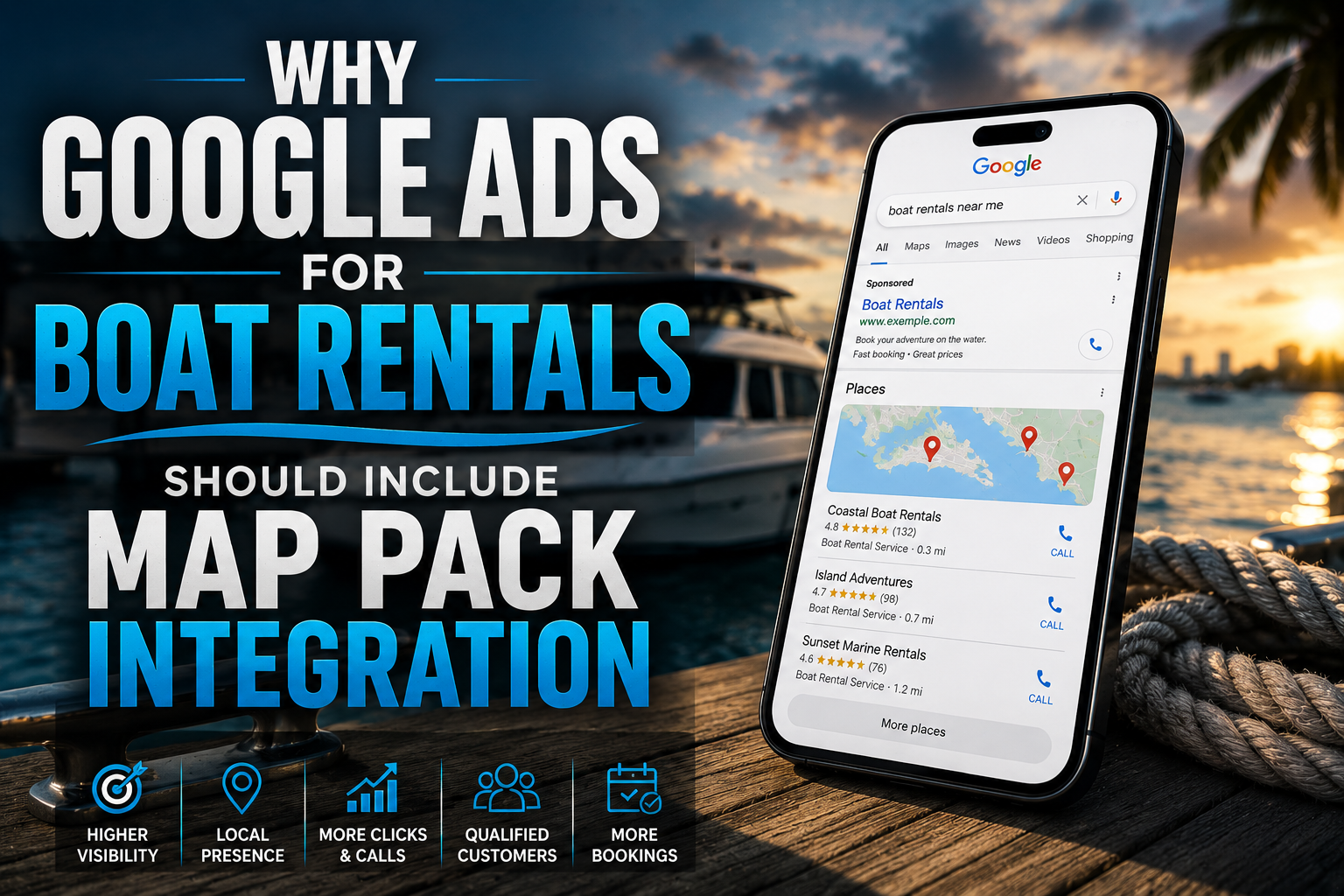
Boat rental marketing is unusually dependent on location.
Someone searching for an accountant or software company may be willing to work with a business hundreds of miles away. Someone searching for a boat rental usually wants to know something much more immediate: Where can I rent a boat near where I am staying, and how quickly can I get on the water?
That difference makes local visibility especially important.
Paid search can place a boat rental company in front of people actively searching for an experience. Google Maps and local results can simultaneously provide the geographic information travelers need to make a decision.
Rather than treating paid search and local SEO as unrelated strategies, boat rental operators can benefit from understanding how the two influence the same customer journey.
Boat Rental Searches Usually Have Strong Local Intent
Consider searches such as:
- Boat rental near me
- Pontoon rental near me
- Boat rentals Miami
- Boat rental Nassau
- Jet ski rental near me
- Private boat rental
- Boat rental marina
- Boat rental for the day
These are not abstract research queries.
In many cases, the searcher is trying to find something they can actually book.
Location immediately becomes part of the decision.
A traveler may want to know:
- How far is the marina?
- Is it close to my hotel?
- Where does the boat depart?
- Is parking available?
- Can I get there without renting a car?
- Is the company actually located in the destination?
Google Maps can answer some of these questions before the customer even visits the website.
The Map Pack and Paid Search Serve Different Purposes
Google’s local results and paid advertisements should not be viewed as interchangeable.
Paid search can help an operator reach customers for strategically important searches.
Local results provide another layer of information involving the business itself.
Depending on the search and Google’s presentation, users may encounter information such as:
- Business name
- Location
- Reviews
- Photographs
- Hours
- Directions
- Website
- Phone information
That local context can become particularly valuable for travelers who are unfamiliar with the destination.
Travelers Need Geographic Reassurance
Imagine planning a vacation somewhere you have never visited.
You search for a boat rental company and find an attractive website.
But you still have questions.
Is the marina actually close to where you are staying?
Is the business located on the correct side of the island?
Will transportation take 10 minutes or an hour?
Maps help transform an unfamiliar destination into something understandable.
For tourism businesses, that geographic reassurance can reduce uncertainty.
Mobile Search Makes Maps Even More Important
Boat rental searches frequently happen on smartphones.
Travelers might search while:
- Sitting at a hotel pool
- Walking around downtown
- Eating breakfast
- Arriving at a cruise port
- Waiting for friends
- Planning tomorrow’s activities
On mobile devices, location-based information becomes especially useful.
Someone can move directly from searching to:
- Calling
- Requesting directions
- Visiting the website
- Comparing nearby options
The distance between discovery and action becomes very short.
“Near Me” Searches Are Particularly Valuable
A search containing “near me” provides an obvious geographic signal.
The customer is not simply asking what boat rentals exist.
They are asking which relevant options exist around their current location.
Google can consider several factors when presenting local results, including relevance, distance, and prominence.
A business therefore needs more than advertising alone to compete effectively across local discovery surfaces.
Paid Visibility Cannot Replace Local Relevance
An advertiser can bid aggressively on a local keyword.
That does not automatically make its Google Business Profile strong.
Likewise, a well-optimized local presence does not guarantee paid advertising will reach every strategically important search.
The channels solve different problems.
Paid search provides control over:
- Keywords
- Budgets
- Bids
- Advertising messages
- Landing pages
- Campaign schedules
Local optimization focuses more heavily on:
- Business information
- Geographic relevance
- Reviews
- Categories
- Photos
- Local prominence
Used together, they can create a more complete search presence.
Google Business Profile Is the Foundation
For businesses eligible for a Google Business Profile, accurate information is essential.
Core details should be reviewed carefully, including:
- Business name
- Address or appropriate service-area configuration
- Phone number
- Website
- Hours
- Primary category
- Secondary categories
- Photos
Accuracy matters more than trying to manipulate every field for keywords.
The profile should represent the real-world business.
The Primary Category Deserves Careful Attention
Google Business Profile categories help describe what the company actually does.
Choosing the closest legitimate primary category can help Google understand the business.
Secondary categories may provide additional context where appropriate.
Operators should avoid adding unrelated categories merely because they appear to have search volume.
Relevance is the objective.
Your Website and Profile Should Tell the Same Story
Imagine the Google Business Profile presents a company as a boat rental business in one location while the website emphasizes an entirely different location.
That inconsistency can confuse customers.
The website should clearly communicate:
- What is offered
- Where rentals depart
- Which areas are served
- How customers book
- How customers reach the departure location
Consistency improves both usability and local clarity.
Location Pages Can Support Multi-Marina Operators
Some boat rental businesses genuinely operate from several locations.
Those companies may benefit from dedicated location pages.
A useful page could include:
- Marina information
- Address
- Available boats
- Local operating area
- Directions
- Parking information
- Hours
- Nearby landmarks
- Booking options
The content should be genuinely specific to that location.
Simply copying one page and changing the city name provides little value to users.
Don’t Create Fake Locations
Local visibility can tempt businesses to create profiles or location pages for areas where they do not actually operate.
That creates unnecessary risk.
A legitimate local strategy should reflect real operations.
If the business serves a destination without maintaining a customer-facing location there, its marketing should describe that accurately rather than inventing an office.
Long-term visibility is more valuable than a temporary shortcut.
Reviews Can Influence the Decision Before the Click
Boat rentals involve trust.
Customers may be handing over substantial money, bringing family members onto the water, or booking an important part of a vacation.
Reviews can help them evaluate:
- Customer service
- Boat condition
- Communication
- Reliability
- Check-in experience
- Overall trip quality
That information can influence whether someone clicks an advertisement, organic result, or map listing.
Review Quantity Is Not the Only Thing That Matters
A business with many reviews may appear established.
But customers also read what people actually say.
Patterns can be more important than the raw number.
For example, repeated comments about:
- Clean boats
- Helpful staff
- Easy check-in
- Clear communication
can reinforce confidence.
Repeated complaints can do the opposite.
Reputation management is therefore part of local search strategy.
Recent Reviews Provide Fresh Context
Travelers often pay attention to recent experiences.
A review from several years ago may still be useful, but a collection of recent reviews tells customers what the business appears to be like now.
Operators can encourage legitimate customers to share feedback without attempting to dictate what those reviews say.
Responding to Reviews Shows Active Management
Thoughtful responses can demonstrate that the business is actively managed.
Responses do not need to be long.
For positive feedback, acknowledge the customer naturally.
For negative feedback, remain professional and avoid turning the response into a public argument.
Remember that the response is being read by future customers as much as by the original reviewer.
Photos Matter Enormously for Boat Rentals
Boat rentals are visual.
Customers want to see:
- Boats
- Seating
- Deck space
- Marina
- Water
- Equipment
- Destinations
High-quality photographs can help people understand what they are booking.
This becomes particularly important when multiple rental options have similar prices.
Show the Actual Boats
Generic tropical photographs may create atmosphere.
They do not necessarily answer the customer’s questions.
If possible, show the actual rental fleet.
Customers may want to understand:
- Boat size
- Seating configuration
- Shade
- Storage
- Condition
Accurate imagery reduces uncertainty.
Include the Departure Environment
The boat itself is only part of the experience.
Photographs of the marina or pickup area can help customers recognize where they need to go.
This can be useful for tourists navigating an unfamiliar destination.
A photograph can sometimes explain arrival logistics more effectively than several paragraphs of instructions.
Hours Need to Be Accurate
Tourism businesses may have:
- Seasonal schedules
- Holiday hours
- Weather-related changes
- Different check-in periods
Outdated hours can create poor customer experiences.
If someone drives to a marina because Google says the business is open and finds it closed, the marketing funnel has failed regardless of how effective the advertisement was.
Paid Campaign Schedules Should Reflect Operations
Advertising should also consider actual availability.
If nobody can respond to calls after a certain hour, the advertiser should understand what happens to late-night leads.
Perhaps online booking remains available.
Perhaps inquiries are followed up the next morning.
The campaign strategy should reflect the business’s real ability to convert demand.
Connect Ads to the Correct Landing Page
A customer searching for:
pontoon rental
should ideally land somewhere that clearly addresses pontoon rentals.
A search for:
private boat charter
may require a different page.
A search for:
boat rental Miami
should not land on a generic national homepage if a relevant Miami page exists.
Landing-page alignment improves the customer journey.
Local Landing Pages Need Useful Information
A good boat rental landing page can answer practical questions immediately:
- Where does the boat depart?
- What types of boats are available?
- How many passengers are allowed?
- What is included?
- What should customers bring?
- Is a captain included?
- What are the age or licensing requirements?
- How does booking work?
The exact answers depend on the operator and local regulations.
Maps Can Reduce Location Friction
Embedding or otherwise clearly presenting location information on relevant website pages can help users understand where the business operates.
The objective is not simply adding a map for SEO.
It is helping a traveler answer:
“Where do I actually go?”
That question becomes particularly important for marinas, which may have multiple docks, entrances, parking areas, or operators within the same property.
Directions Should Be Written for Visitors
Locals may know exactly where a marina is.
Tourists may not.
Useful directions can reference recognizable starting points such as:
- Airport
- Cruise port
- Major hotel district
- Downtown
- Popular landmark
Keep directions concise.
Customers should not need a geography lesson to reach the boat.
Parking Information Can Increase Confidence
A customer driving to a marina may wonder:
- Is parking available?
- Is it free?
- Do I need to arrive early?
- Is the lot close to the dock?
Providing this information can remove another small obstacle between booking and arrival.
These details may not sound like marketing, but reducing uncertainty is often what effective local marketing does.
Cruise Passengers Have Special Geographic Needs
Boat rental and charter businesses serving cruise destinations should think carefully about cruise passenger behavior.
These customers may have:
- Limited time
- Fixed ship schedules
- No personal vehicle
- Little familiarity with the destination
They need clear information about transportation and timing.
A vague statement such as “located nearby” is less useful than accurate logistical guidance.
Hotel Guests Search Differently
Hotel guests may search using the hotel or neighborhood as a geographic reference.
Examples might include:
- Boat rentals near downtown
- Boat rental near resort
- Boat rental near marina
- Boat rental near beach
Keyword research should therefore include how visitors actually describe their location, not merely official city names.
Local Search Terms Reveal Customer Geography
Search-term reports can reveal how customers think about the destination.
You may discover searches containing:
- Neighborhood names
- Marina names
- Beaches
- Islands
- Resorts
- Landmarks
These patterns can influence both paid campaigns and local content strategy.
PPC Search Data Can Inform Local SEO
One of the biggest advantages of coordinating channels is shared data.
Paid campaigns can reveal:
- Which local keywords receive impressions
- Which terms generate clicks
- Which locations convert
- Which services attract demand
- Which search language customers use
That information can help prioritize local SEO efforts.
Instead of guessing which geographic terms matter, the business can study actual customer behavior.
Local SEO Can Inform Paid Search Too
The information flow works in both directions.
Local SEO research may identify:
- Important neighborhoods
- Common local terminology
- Nearby landmarks
- Service-area distinctions
- Location-specific questions
Those insights can then influence advertising campaigns.
Paid and organic teams should not operate as if they serve different customers.
They are often reaching the same people at different moments.
Google Ads for Boat Rentals Works Better as Part of a Local Search System
A strong Google Ads for Boat Rentals strategy should account for the fact that customers may move between advertisements, Maps, reviews, organic results, and the website before booking. Someone may first notice an ad, search the company name afterward, read its reviews, inspect photos on its Business Profile, check the marina location, and only then return to the website to reserve.
That journey does not belong exclusively to PPC or SEO.
It belongs to the customer.
Integration helps ensure that each search touchpoint reinforces the others.
Branded Searches Can Increase After Ad Exposure
Paid advertising can introduce people to a business name.
Some users click immediately.
Others remember the name and search for it later.
When that happens, the branded search results become part of the advertising experience.
A strong local presence can support that second interaction.
If the user searches the company name and finds:
- Accurate information
- Strong reviews
- Current photos
- Correct hours
confidence can increase.
Weak Local Information Can Undermine a Strong Ad
Imagine seeing a polished advertisement, clicking through to an excellent website, and then searching the company name on Maps.
The profile shows:
- Incorrect hours
- Few photographs
- An outdated phone number
- Confusing location information
Suddenly the business feels less trustworthy.
Marketing channels do not exist in isolation from one another.
Customers see the combined experience.
Track More Than Website Form Submissions
Boat rental customers may convert in several ways.
Potential actions include:
- Online booking
- Phone call
- Contact form
- Text inquiry
- Direction request
- Website visit from Maps
Not every action has equal business value.
Tracking should focus on meaningful outcomes rather than maximizing every measurable interaction.
Calls Can Be Particularly Important
Tourism customers often have questions before booking.
They may want to know:
- Whether a boat is available today
- Passenger limits
- Captain requirements
- Weather policy
- Departure time
- What is included
Phone calls can therefore represent valuable leads.
Advertising analysis should account for calls where appropriate.
Call Quality Matters More Than Call Volume
A campaign generating 100 calls is not necessarily better than one generating 50.
What happened during those calls?
Were people asking relevant booking questions?
Did they reserve?
Were they calling for unrelated services?
Connecting marketing data with actual booking outcomes provides a much clearer picture.
Track Completed Bookings
The ultimate goal for most boat rental advertising is not simply traffic.
It is booked rental revenue.
Whenever technically possible, evaluate:
- Bookings
- Booking value
- Rental type
- Lead source
This helps identify which campaigns and local markets produce meaningful business results.
Revenue Can Tell a Different Story Than Leads
Imagine two campaigns:
Campaign A
20 bookings at an average value of $300.
Campaign B
10 bookings at an average value of $900.
Campaign A produces twice as many bookings.
Campaign B produces more revenue.
That distinction can dramatically change budget decisions.
Geographic Performance Should Be Reviewed
Location reports can reveal where customers are searching from.
For a tourism business, this can produce interesting patterns.
Customers may search:
- Before traveling
- After arriving
- From nearby hotels
- From another state
- From another country
Understanding these patterns can influence campaign timing and messaging.
Local Customers and Tourists May Need Different Messaging
A local resident renting a boat for Saturday may already understand the area.
A tourist planning from Chicago may need much more information.
The tourist may care about:
- Marina location
- Transportation
- What to bring
- Local destinations
The resident may care more about:
- Availability
- Boat type
- Price
Segmentation can help advertisements and landing pages respond appropriately.
Don’t Over-Restrict Geography Without Looking at Booking Behavior
A boat rental business is physically local.
Its customers may not be.
This is an important distinction.
If the operator advertises only to people currently within ten miles of the marina, it could miss travelers researching their vacation weeks in advance.
Geographic targeting should reflect the booking window.
Search Intent and User Location Are Different Signals
Someone physically located in Ohio might search:
boat rentals Nassau Bahamas
Their physical location is Ohio.
Their search intent is Nassau.
That user may be highly valuable because they are planning a trip.
Campaign strategy should distinguish between where someone currently is and where they intend to travel.
Use Geographic Keywords Thoughtfully
Destination keywords can help identify strong intent.
Examples include combinations involving:
- City
- Island
- Beach
- Marina
- Tourism district
But advertisers should avoid creating hundreds of low-quality city variations simply for the sake of coverage.
Focus on locations customers genuinely use when searching.
Map Pack Visibility Is Competitive
Boat rental destinations often contain multiple operators concentrated around the same waterfront.
That makes local competition intense.
Businesses may compete on:
- Proximity
- Relevance
- Reviews
- Prominence
- Website authority
- Profile quality
No single optimization guarantees a top local position.
The objective should be improving the overall strength and accuracy of the business’s local presence.
Review Competitors Like a Customer
Search important local terms and examine what customers see.
Look at:
- Review patterns
- Photos
- Categories
- Website quality
- Location information
- Offers
The goal is not to copy competitors.
It is to understand the standard customers encounter before they reach your business.
Competitor Research Can Reveal Content Gaps
Perhaps competitors fail to explain:
- Parking
- Captain requirements
- Fuel policies
- Cancellation rules
- Pickup procedures
Those gaps can become opportunities.
Useful content differentiates a business without relying entirely on promotional language.
Google Business Profile Photos Should Stay Current
A boat rental fleet can change.
New boats arrive.
Older boats leave.
Marinas are renovated.
Branding changes.
Profile photos should represent the current experience.
A customer should not arrive expecting a boat shown prominently online only to learn it left the fleet two years ago.
Seasonal Updates Matter
Boat rental businesses may experience significant seasonality.
Profile and website information should reflect changes involving:
- Hours
- Fleet availability
- Seasonal services
- Weather
- Booking schedules
Paid campaigns should also adjust according to real demand.
Weather Can Change Search Behavior Quickly
Boat rental demand is unusually sensitive to weather.
A beautiful weekend forecast can increase last-minute searches.
Poor conditions can reduce immediate demand.
Campaign managers can consider how weather patterns influence:
- Search volume
- Booking windows
- Cancellations
- Customer questions
However, safety decisions should always remain operational rather than being driven by advertising pressure.
Last-Minute Searchers Can Be Extremely Valuable
A traveler searching:
boat rental today
may be close to booking.
Landing pages and local information should make immediate questions easy to answer.
For example:
- Is online booking available?
- Can customers call for same-day availability?
- Where is the marina?
- What time should they arrive?
Reducing friction becomes especially important for high-intent, last-minute demand.
Availability Messaging Must Be Accurate
Do not advertise “available today” unless the business can support that claim.
Nothing damages trust faster than creating urgency around inventory that does not exist.
If availability changes constantly, direct users toward a live booking system or clear contact method.
Map Visibility Can Support Same-Day Demand
When someone is already in the destination, Maps becomes particularly useful.
They may simply want to see:
Which rental companies are nearby and open?
This is where accurate hours, location information, reviews, and photos become directly connected to conversion potential.
Use Landing Pages That Load Quickly on Mobile
Tourists may be using cellular connections rather than fast home Wi-Fi.
Heavy pages filled with enormous videos and unoptimized images can create unnecessary delays.
Mobile landing pages should make critical information immediately accessible:
- Boat options
- Pricing or quote process
- Availability
- Location
- Booking
- Phone number
Visual appeal matters, but speed matters too.
Booking Buttons Should Be Easy to Find
Do not make someone hunt through the site to rent a boat.
A high-intent visitor should quickly understand the next step.
Depending on the business, that may be:
Check Availability
Book Online
Call for Availability
The action should match the actual booking process.
Local Information Should Be Visible Before the Footer
If location is central to the decision, do not hide the address or departure information at the very bottom of the website.
Customers should understand quickly:
- Where the company operates
- Where they need to go
This is particularly important when the company name itself does not contain a geographic reference.
Structured Data Can Clarify Business Information
Appropriate structured data can help search engines interpret business information on the website.
Implementation should accurately reflect the real business.
Structured data is not a shortcut to local rankings.
It is a method of providing clearer machine-readable information.
Keep Business Information Consistent Across Major Sources
Major inconsistencies involving:
- Business name
- Address
- Phone
- Website
can confuse customers.
Businesses should periodically review important listings and correct outdated information.
This is particularly relevant after:
- Moving marinas
- Changing phone numbers
- Rebranding
- Updating websites
Old information can remain online surprisingly long.
Local Links Can Build Geographic Relevance
Boat rental businesses naturally participate in local tourism ecosystems.
Legitimate relationships may exist with:
- Hotels
- Tourism organizations
- Marinas
- Local publications
- Attractions
- Event organizations
These relationships can generate referral traffic and potentially relevant local links.
The focus should be real partnerships rather than manufacturing links solely for rankings.
Hotel Partnerships Can Produce Valuable Traffic
Hotel guests frequently ask staff:
“What should we do tomorrow?”
Boat rentals are an obvious answer in waterfront destinations.
Building legitimate relationships with local hospitality businesses can therefore support both offline referrals and digital visibility.
This is one example of where traditional tourism marketing and SEO overlap naturally.
Marina Relationships Matter Too
Marinas are central geographic entities for boat rental businesses.
Accurate references to the departure marina across the website and local presence can help customers understand where the operation actually occurs.
If several operators share the same marina, clear directions become even more important.
Content Can Target Pre-Trip Questions
Not every useful search is immediately transactional.
Travelers may search:
- Best places to boat near destination
- What to bring on a boat rental
- Do I need a boating license
- Best islands to visit by boat
- Boat rental vs charter
Helpful content can introduce the company earlier in the planning process.
Paid search can then capture stronger transactional demand.
Destination Guides Can Support Local Discovery
A boat rental website has a natural reason to discuss local waterways.
Useful guides might cover:
- Nearby islands
- Beaches accessible by boat
- Sandbars
- Snorkeling areas
- Suggested itineraries
These pages should genuinely help travelers plan rather than existing solely to insert geographic keywords.
Don’t Confuse Content Traffic With Booking Intent
A guide titled “Best Beaches in the Bahamas” may attract large traffic.
That does not mean every visitor wants a boat rental.
Measure informational content separately from high-intent landing pages.
Different content plays different roles in the customer journey.
Remarketing Can Reconnect With Trip Planners
Travel purchases are not always immediate.
Someone might research boat rentals six weeks before vacation and return later.
Remarketing can potentially keep the business visible during that decision period.
The messaging should reflect where the customer is in the process rather than showing the same generic advertisement indefinitely.
Local Presence Can Reinforce Remarketing
Suppose a traveler first discovers the business through a paid campaign.
Later they see another advertisement.
Then, after arriving in the destination, they search the brand on Maps.
Consistent branding and information across these interactions can increase recognition.
This is another reason integration matters.
Map Pack Integration Is Really About Customer Behavior
“Integration” can sound like a technical marketing term.
In practice, the concept is much simpler.
Customers do not care whether something belongs to:
- PPC
- SEO
- Maps
- Reputation management
- Conversion optimization
They search.
They compare.
They check reviews.
They look at photos.
They confirm the location.
They visit the website.
They book.
Marketing should reflect that behavior.
Common Mistakes Boat Rental Businesses Should Avoid
Running Ads Without Maintaining the Business Profile
A neglected local presence can undermine confidence generated through advertising.
Sending Every Keyword to the Homepage
Different searches may require different landing pages.
Ignoring Reviews
Customers frequently evaluate reputation before booking tourism experiences.
Targeting Only People Already Near the Marina
Future tourists may research well before arriving.
Creating Fake Locations
Local strategy should reflect genuine business operations.
Using Outdated Fleet Photos
Customers should see what they can actually rent.
Tracking Clicks Instead of Bookings
Traffic alone does not pay for boats, fuel, staff, or marina costs.
Ignoring Mobile Experience
Many tourism searches happen on phones.
A Practical Integration Framework
Boat rental operators can approach paid and local search together.
Step 1: Audit the Google Business Profile
Verify essential business information.
Step 2: Review the Website
Confirm that location and departure information are easy to find.
Step 3: Organize Paid Keywords by Intent
Separate major rental types, destinations, and customer needs.
Step 4: Match Landing Pages
Send users to the most relevant page available.
Step 5: Review Local Search Visibility
Understand where and how the business appears for important searches.
Step 6: Improve Visual Information
Keep fleet and marina photographs current.
Step 7: Build a Legitimate Review Process
Encourage real customers to provide honest feedback.
Step 8: Track Conversions
Measure calls, bookings, and revenue where possible.
Step 9: Share Data Across Channels
Use PPC search terms to inform local SEO and local insights to improve PPC.
Step 10: Review Performance Regularly
Customer behavior, competitors, seasons, and search results change.
Integration should evolve with them.
Questions Boat Rental Operators Should Ask
A useful review can begin with:
- Can customers immediately identify our departure location?
- Are our Business Profile hours accurate?
- Do our photos show the current fleet?
- Are recent customer reviews visible?
- Which local keywords generate actual bookings?
- Are paid ads sending visitors to relevant landing pages?
- Are we reaching travelers before they arrive?
- Are we tracking calls and completed bookings?
- Do our website and Business Profile provide consistent information?
- What does a customer see when searching our brand after clicking an ad?
These questions focus attention on the complete customer journey.
FAQs
What is the Google Map Pack?
The Map Pack is the local search feature that can display geographically relevant businesses alongside map information for certain searches. The exact presentation can vary according to query, device, and other factors.
Why are Maps important for boat rental companies?
Boat rentals are strongly location-dependent. Customers often need to know where the marina is, how far it is from their accommodations, whether the business is open, and how to reach the departure point.
Can Google Ads improve Map Pack rankings?
Paid advertising and local organic visibility are different systems. Businesses should not assume that spending more on ads directly produces higher organic local rankings. The value of integration comes from creating a stronger overall search presence and customer journey.
Should boat rental businesses target “near me” keywords?
They can be valuable because they often indicate strong local intent. However, advertisers should also consider destination searches made by travelers before they arrive.
Should a boat rental company have a Google Business Profile?
Eligible businesses can benefit from maintaining an accurate profile because customers frequently use Google Search and Maps to evaluate local tourism businesses. Operators should follow Google’s eligibility and representation guidelines.
What should boat rental businesses track from paid search?
Useful metrics can include qualified calls, online bookings, booking value, cost per acquisition, search terms, geographic performance, and lead quality rather than focusing only on impressions and clicks.
Final Thoughts
Boat rental marketing is local by nature, even when the customer begins searching from hundreds or thousands of miles away.
Eventually, every booking becomes geographic.
The traveler needs to know where the boat is, where to meet, how to get there, and whether the operator appears trustworthy.
Paid search can capture demand at critical moments. Maps can provide geographic context. Reviews can reduce uncertainty. Photographs can show customers what they are booking. Landing pages can answer practical questions. Conversion tracking can reveal which searches actually produce revenue.
The mistake is treating each of those elements as an isolated marketing project.
A traveler may interact with several of them before spending a dollar.
For boat rental operators, the stronger strategy is therefore not simply maximizing visibility in one part of Google. It is creating a consistent path from the initial search to the marina.
When the advertisement, local presence, website, reviews, and real-world location all tell the same story, customers have fewer questions standing between “boat rental near me” and “booking confirmed.”